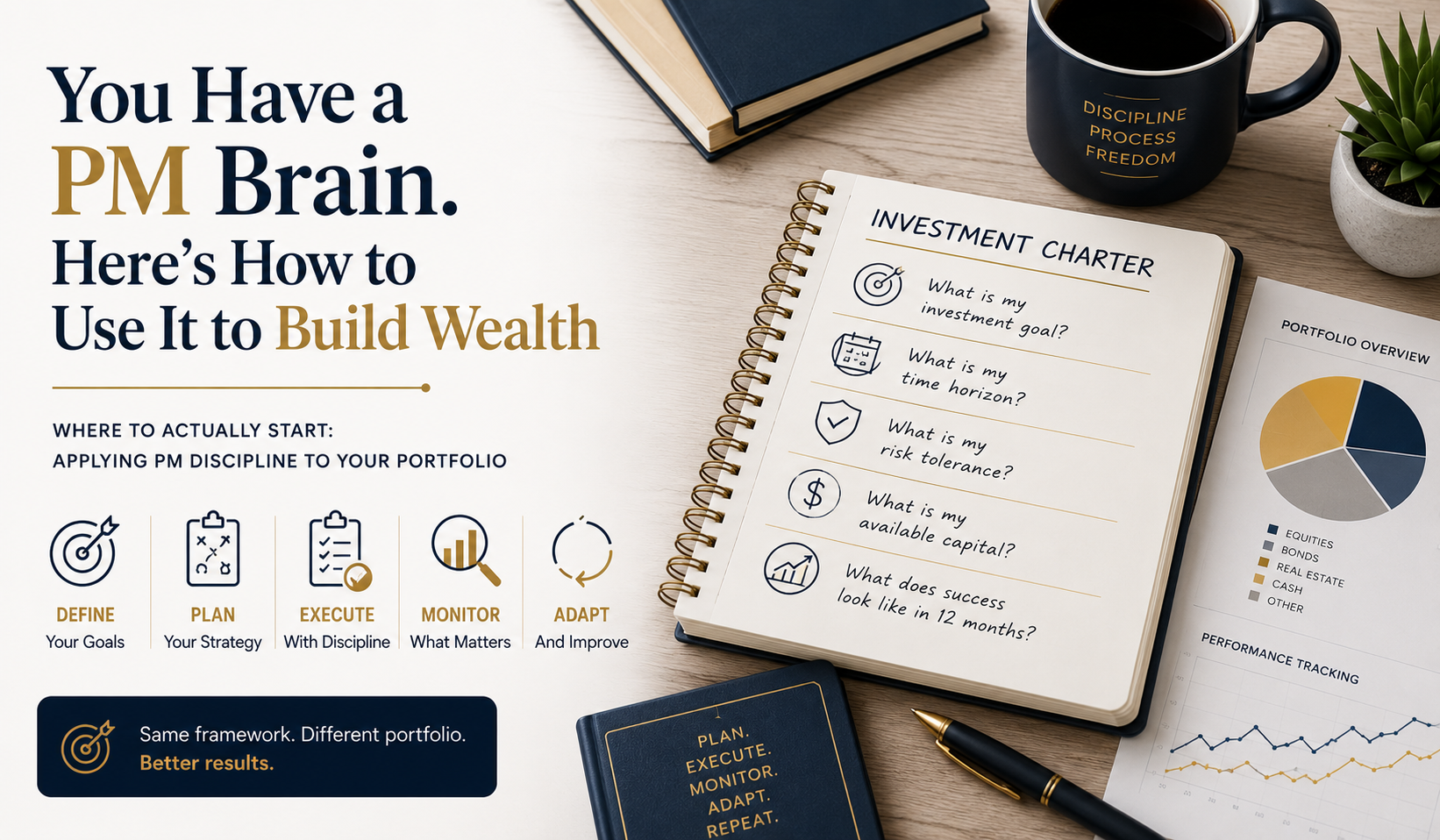
Where to Actually Start: Applying PM Discipline to Your Portfolio
Last week I wrote about how I use project management frameworks to manage my investment portfolio.
The response surprised me.
Hundreds of PMs, consultants, and business professionals reached out saying the same thing in different ways: “I never thought about it like that, but you’re right! I already have the skills. I just never applied them here.”
So this article is for everyone who read the first one and asked the natural follow-up question:
Where do I actually start?
Because knowing the framework is one thing. Implementing it is another. And the gap between those two things is where most people get stuck.
Here’s exactly how I started … and how you can too.
First, Understand Why PMs Are Wired Differently Than Most Investors
Before we get into the how, I want to spend a moment on the why. Understanding this changes the way you approach markets entirely.
Most retail investors are driven by two things: excitement and fear.
They buy when markets are exciting and everyone is talking about how much money they’re making. They sell when markets are fearful and everyone is talking about how much money they’re losing. This is the exact opposite of what builds wealth, and it’s entirely driven by emotion rather than process.
Project managers are trained to do something different.
We are trained to zoom out when everyone else is zooming in. When a project is in crisis due to deadlines missed, stakeholders panicking, or the team being overwhelmed, a good PM doesn’t react emotionally. They assess the situation, consult the plan, identify options, and make a structured decision.
That is precisely the skill that separates consistently profitable investors from the 90% who lose money over time.
You’ve been training for this your entire career. You just haven’t been paid for it in the markets. Yet.
Step 1: Write Your Investment Charter This Weekend
I mean this literally. Block two hours this weekend and write it.
Not a mental note. Not a rough idea. A written document, even if it’s one page in a Google Doc or a notes app.
Answer these five questions in writing:
- What is my primary investment goal? Be specific. “Make money” is not a goal. “Generate $2,000 per month in supplemental income within 18 months” is a goal. “Grow my portfolio by 20% annually over the next 3 years” is a goal. Specific, measurable, and time-bound. You know this framework already — you are very familiar with this drill.
- What capital am I starting with — and what is my maximum acceptable loss? This is your project budget. Decide in advance what you are willing to lose before you stop and reassess. Not what you hope to lose, but what you can genuinely afford to lose without it affecting your life. For most people starting out, this is a smaller number than their ego wants it to be. That’s okay. Start small. The market will be there when your account grows.
- What is my time horizon? Are you thinking short-term (days to weeks), medium-term (months), or long-term (years)? Your time horizon determines everything — what instruments you trade, how often you check your portfolio, and what “success” looks like at each checkpoint.
- How much time can I realistically commit? Active trading requires active attention. If you have a full-time consulting practice, a family, and other commitments, you need a strategy that fits your life — not one that requires you to watch charts for eight hours a day. Be honest with yourself here. A strategy you can’t execute consistently will always underperform a simpler strategy you can.
- What does my 90-day milestone look like? Not 5 years from now. 90 days. What specific, measurable result would tell you that you’re on the right track? Define it before you start so you have something to evaluate yourself against. Not just a feeling.
When you’re done, you have your Investment Charter. Save it somewhere you’ll see it regularly. Review it monthly. Update it as your situation changes.
Step 2: Build Your Risk Register Before You Place a Single Trade
I cannot stress this enough: the risk register comes before the first trade, not after.
One of the most common and costly mistakes new investors make is learning their risk tolerance by losing money. Don’t do that. Define it in advance.
Your trading risk register doesn’t need to be complex. Start with these five risks and define your mitigation strategy for each:
Risk 1: A single trade moves significantly against me.
Mitigation: Pre-defined stop loss on every trade, set at the time of entry, never moved to accommodate hope.
Risk 2: I have a bad day and start chasing losses.
Mitigation: A daily maximum loss limit. If I lose X amount in a single day, I stop trading for that day. Full stop. No exceptions.
Risk 3: I become overconfident after a winning streak.
Mitigation: Position size caps that don’t increase based on recent performance. A win streak doesn’t change the underlying risk of the next trade.
Risk 4: I make emotional decisions during market volatility.
Mitigation: Rules-based entry and exit criteria defined in advance. If the rules say exit, I exit — regardless of what I feel in that moment. This can be very hard for some people.
Risk 5: I overtrade out of boredom or FOMO.
Mitigation: A defined number of maximum trades per day. Quality over quantity. The best traders I know take fewer trades, not more.
Write these down. Make them specific to your situation. Then commit to honoring them the same way you’d honor a signed project contract.
Step 3: Start Your Trading Journal on Day One
Most people think the trading journal is something you start once you’re “serious enough.”
That thinking is exactly backward.
The journal is how you become serious. It is the feedback loop that turns random activity into deliberate practice. And as any good PM knows, you cannot improve what you do not measure.
Your journal doesn’t need to be sophisticated. A spreadsheet works. A notebook works. There are dedicated trading journal apps if you want something purpose-built. What matters is consistency, not format. If you need one, type “trade journal” in comments and I will follow up.
For every trade, capture:
- Date and time
- Instrument traded
- Entry price and exit price
- Position size
- Your thesis — why did you take this trade? What were you seeing?
- Result — profit or loss
- What happened vs. what you expected
- Emotional state — were you calm, anxious, overconfident, distracted?
- What you’d do differently
Review your journal weekly. Look for patterns. Where are your best trades coming from? Where are your losses clustering? Is there a time of day when you consistently underperform? An instrument that isn’t working for your style?
The journal is your project status report. It tells you the truth about your performance when your emotions are telling you something else.
Step 4: Run Monthly Retrospectives — Seriously
At the end of every month, sit down with your journal and run a formal retrospective.
I know this sounds like overkill. I promise it isn’t.
Ask yourself:
- What worked this month?
- What didn’t work?
- Where did I follow my plan? Where did I deviate?
- What would I tell a team member who performed the way I performed this month?
That last question is the most powerful one. We are often far harder on our project teams than we are on ourselves as investors. We accept sloppy execution from ourselves that we would never accept from a direct report.
Hold yourself to the same standard you hold your projects.
The Bigger Picture
I want to leave you with something that goes beyond tactics.
Building wealth through investing is a long game. It rewards patience, discipline, process, and continuous improvement. These are the same qualities that make a great project manager.
It punishes impulsiveness, ego, inconsistency, and the absence of a plan. These are practically the same things that sink projects.
You have spent years, maybe decades, building exactly the right mental models for this. The planning instinct. The risk awareness. The process orientation. The ability to stay calm when everything around you is in chaos.
The market doesn’t know you’re a PM. But you do. Wink wink.
Use it.
KTR Wealth, LLC is a financial education and coaching company. Nothing on this website constitutes financial advice, investment advice, legal advice, or tax advice. Results vary based on individual circumstances, effort, and the application of strategies taught. Always consult a qualified financial advisor, tax professional, or legal professional before making significant financial decisions. Keniesha T. Rhooms is a PMP certified Management Consultant and financial educator, not a licensed financial advisor, attorney, or certified public accountant.