The PM Framework I Use to Manage My Investment Portfolio

The PM Framework I Use to Manage My Investment Portfolio

Most people think project management and investing have nothing in common.

One is about deadlines, stakeholders, and deliverables. The other is about charts, capital, and conviction.

But after 14 years as a project manager and management consultant, and several years trading futures markets, I’ve come to believe that the skills that make a great PM are the exact same skills that make a disciplined investor. The frameworks are nearly identical. Most traders just don’t know it yet.

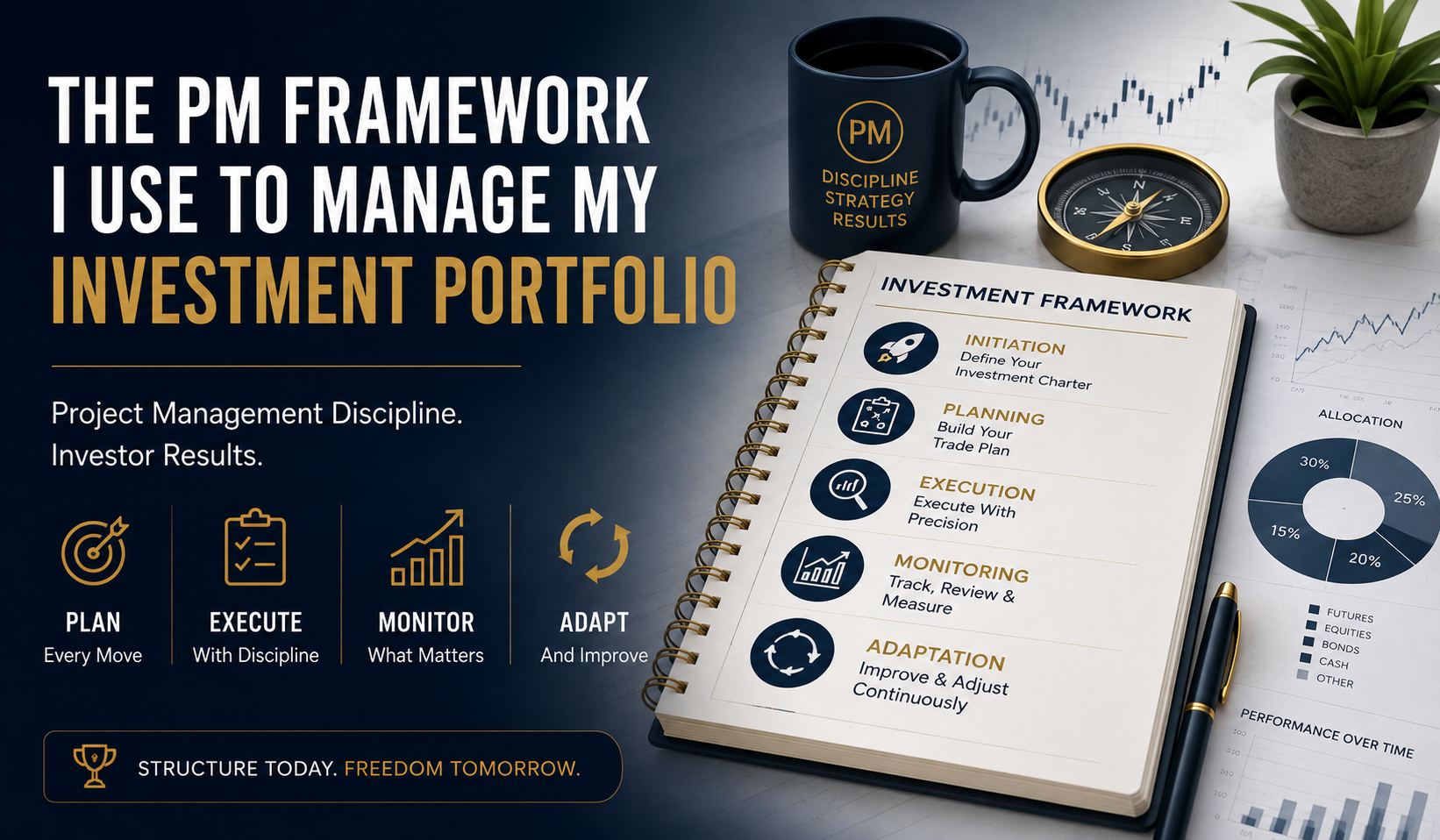
Here’s the framework I use, and how I applied PM principles to bring structure, discipline, and consistency to my portfolio.

Phase 1: Initiation — Define Your Investment Charter

Every project starts with a charter. A document that answers the fundamental questions: What are we doing? Why are we doing it? What does success look like?

Most investors skip this step entirely. They open a brokerage account, fund it, and start trading based on tips, headlines, or gut feelings. Then they wonder why they’re inconsistent.

My investment charter answers five questions before I place a single trade:

  1. What is my investment objective? Income generation, capital appreciation, or both?
  2. What is my time horizon? Am I thinking in days, months, or years?
  3. What is my risk tolerance? Not what I say it is in calm markets, but what it actually is when I’m down 15%?
  4. What is my available capital? And critically, what is the maximum I am willing to lose?
  5. What does success look like in 12 months? A specific, measurable target — not “make money.”

As PMs, we would never kick off a project without defining scope, objectives, and success criteria. Your portfolio deserves the same rigor.

Phase 2: Planning — Build Your Trade Plan Like a Project Plan

In project management, a detailed project plan is non-negotiable. It outlines tasks, timelines, dependencies, resources, and risk mitigation strategies.

In futures trading, this is your trade plan — and most retail traders don’t have one.

My trade plan includes:

Scope definition: Which markets am I trading? (I focus on a select few futures instruments rather than chasing every opportunity — just as a focused project scope beats scope creep every time.)

Work Breakdown Structure (WBS): I break my trading week into structured activities:

  • Pre-market analysis (daily, 30 minutes)
  • Active trading window (defined hours only)
  • End-of-day review and journaling
  • Weekly performance review
  • Monthly portfolio assessment

Resource planning: How much capital is allocated per trade? Per week? I treat my trading capital like a project budget — you don’t blow the entire budget on one work package.

Milestones: Weekly P&L targets, monthly drawdown limits, quarterly strategy reviews. Measurable checkpoints keep you accountable.

The discipline of planning is what separates professional traders from gamblers. PMs are trained planners. That’s an enormous competitive advantage most of us never use.

Phase 3: Risk Management — Your Risk Register Is Your Trading Edge

This is where project management gives traders the most valuable gift of all.

Every PM knows how to build a risk register. You identify potential risks, assess their probability and impact, and define mitigation strategies before they materialize. You don’t wait for the risk to hit; you plan for it in advance.

In trading, this is called risk management, and it is the single most important determinant of long-term success. More important than your entry strategy. More important than your indicators. More important than market timing.

My trading risk register asks:

The key principle from PM risk management that transformed my trading: you define your response to a risk BEFORE it happens, not during it.

When you’re in a losing trade and your P&L is bleeding red, your judgment is impaired. Emotions take over. The PM who pre-planned the response — stop loss at X, maximum daily loss at Y — is protected by their plan. The trader who “wings it” blows their account.

Phase 4: Execution — Manage the Work, Not the Noise

In project execution, a PM’s job is to keep the team focused on the plan while managing distractions, stakeholder noise, and scope creep.

In trading, execution means placing trades according to your plan — and ignoring everything else.

The “noise” in trading is deafening:

  • Financial news channels creating urgency around every market movement
  • Social media traders showing only their winning trades
  • Hot tips from colleagues, friends, and online forums
  • Your own fear and greed whispering at you constantly

My PM instinct kicks in here: is this information relevant to the project plan, or is it noise?

I ask myself three questions before acting on any new information:

  1. Does this change my fundamental thesis on this trade?
  2. Is this within the scope of my trading plan?
  3. Would I have included this as a trigger in my plan if I had known it in advance?

If the answer to all three is not a clear yes, I ignore it and execute the plan.

Scope creep kills projects. Impulse trades kill portfolios.

Phase 5: Monitoring & Controlling — Your Trading Journal Is Your Status Report

No PM would run a project without regular status reports. How are we tracking against the plan? Are we on schedule? On budget? What issues need to be escalated?

Your trading journal is your status report. And if you’re not keeping one, you are flying blind.

My journal captures on every trade:

  • Entry price, exit price, and position size
  • The reasoning behind the trade (what was my thesis?)
  • What actually happened vs. what I expected
  • What I did well and what I would do differently
  • My emotional state during the trade

That last one matters more than most traders want to admit.

At the end of each week, I run a performance review — just like a project status meeting. I look at:

  • Win rate vs. target
  • Average win size vs. average loss size (my risk/reward ratio)
  • Trades where I deviated from my plan and why
  • Patterns in my mistakes

The goal is continuous improvement — the same thing we chase in every project retrospective.

Phase 6: Closing — The Retrospective That Makes You Better

Every project ends with a lessons-learned session. What went well? What would we do differently? What do we carry into the next project?

Every month, I close my trading month with a formal retrospective:

What worked? Which strategies, instruments, and setups performed as expected?

What didn’t work? Where did I deviate from the plan? Where did the market behave in ways I hadn’t anticipated?

What do I stop doing? Which habits are costing me money?

What do I start doing? What new approaches do I want to test in controlled, small-scale experiments first?

What do I continue doing? Which behaviors and strategies are consistently producing results?

This is the sound-and-speed review meeting most traders never hold with themselves. It is the difference between repeating mistakes and compounding on success.

The Bottom Line

The skills you’ve spent years building as a project manager — the planning, risk management, execution discipline, performance monitoring, and continuous improvement — are precisely the skills that elite traders and investors use every day.

Most retail investors lose money not because they lack intelligence or market knowledge. They lose because they lack process.

You already have the process. You just have to apply it.

I built my investment framework not by studying trading gurus, but by looking at what already worked in my professional life and asking: how does this translate?

The answer changed everything.

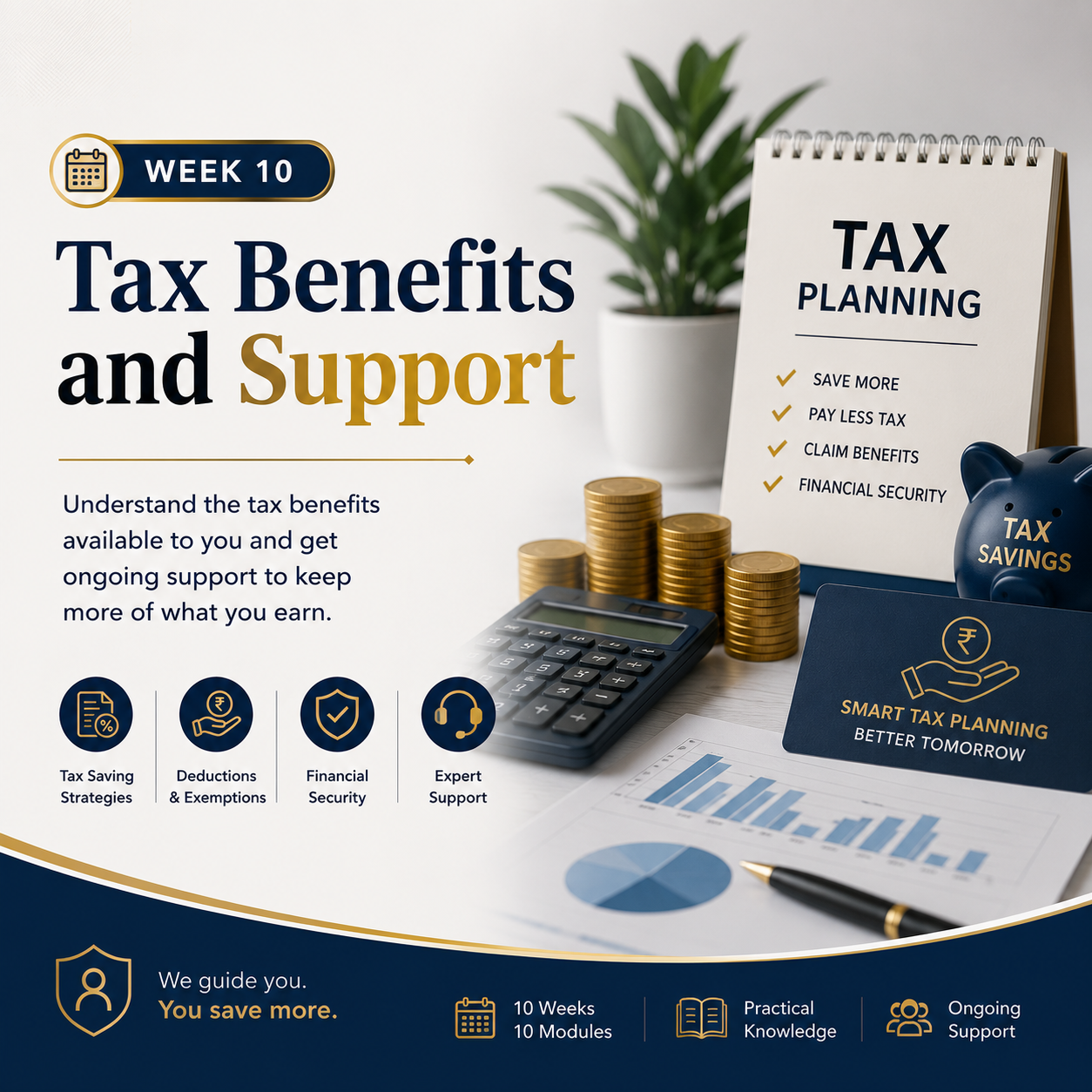
Tax Benefits and Additional Support

I saved this module for last not because it is the least important but because by this point in the program you will have the full context to understand why it matters so much. The money you keep is every bit as valuable as the money you earn. And most people who are building wealth through businesses and real estate are using the tax code in ways that dramatically reduce what they owe legally, ethically, and consistently. That is not a secret available only to the very wealthy. It is knowledge available to anyone who takes the time to understand how the rules actually work. In this module I am going to walk you through the primary tax advantages available to business owners and real estate investors, how to structure your activities to access those advantages, and how to find and work with the right tax professional to make sure you are never leaving legal deductions on the table. This is not tax advice. This is financial education. And for many students it turns out to be the highest return hour in the entire program.

Outcomes

  • Understand the primary tax advantages available to business owners and how they differ fundamentally from what employees have access to, including deductions, depreciation, and business expense treatment
  • Learn how to legally match your business expenses to your income streams to reduce your taxable income so you keep more of what you earn
  • Understand the tax treatment of real estate investments including depreciation deductions, rental income structuring, and how real estate investors use the tax code to their advantage year after year
  • Identify the right type of tax professional for your situation and the specific questions to ask them so you are working with someone who understands wealth building, not just tax filing
  • Complete the program with a full integrated picture of how business ownership, real estate investment, smart savings, and tax strategy work together as a unified and self-reinforcing wealth building system

Real Estate: Building Wealth You Can See

Real estate changed my financial life. Not just buying my first home, although that was a significant milestone. What changed everything was understanding how to build a portfolio of properties that generate income every single month regardless of whether I am actively working or not. That is exactly what I mean when I talk about assets that work for you when you stop working. In this module I am not teaching from a textbook. I am teaching from a portfolio I built myself, property by property, starting from a position where I had no credit and had to build everything from the ground up. I am going to show you how I positioned myself for competitive financing, how I evaluated properties as investments rather than just as homes, what house hacking is and how it can dramatically accelerate your timeline to owning multiple properties, and how to build the right professional team around you. Nobody builds a real estate portfolio alone and knowing who you need and when you need them is as important as knowing how to find the right property.

Outcomes

  • Understand exactly what mortgage lenders look for and how to position your credit profile, income documentation, and debt ratios to qualify for the most competitive terms available to you
  • Learn the concept of house hacking in detail, including how to structure your first property purchase so that rental income offsets or eliminates your mortgage payment entirely
  • Understand how to evaluate any property as an investment using real financial metrics including cash on cash return, cap rate, and net operating income, not just whether you like the house
  • Build the right professional team around your real estate journey including who you need, what to look for in each person, and the questions to ask before you hire them
  • Develop a real estate entry strategy that is specific to your current financial position, whether you are purchasing your first home or your next investment property
  • Leave this module with a clear, actionable real estate plan that connects to your broader wealth building timeline

Business Accelerator

I have launched and run several businesses. Some active, meaning they require my ongoing time and attention. Some passive, meaning they generate income whether I am working that day or not. And I can tell you from genuine experience that the decision to start a business changes the entire structure of your financial life in ways that a salary raise never can. A business gives you access to tax advantages that employees simply do not have. It gives you the ability to build something whose value grows independently of your direct labor. And when it is structured well it becomes an asset, not just a job you gave yourself. In this module I am going to be honest about both sides because the benefits are real and so are the pitfalls. You are going to leave this module knowing what type of business makes sense for your specific life, your skills, and your available resources right now.

Outcomes

  • Understand the real difference between active and passive business models and what each one genuinely requires from you in time, capital, and ongoing attention
  • Separate business myths from business reality so you go in with clear eyes, honest expectations, and a plan that accounts for what it actually takes
  • Identify business ideas that build directly on your existing skills, experience, and professional network so you are not starting from zero but from a position of genuine advantage
  • Understand the tax structure of business ownership and how to set up your business in a way that legally reduces your taxable income from the very beginning
  • Build a structured action plan for your best business idea with milestones, resource requirements, and a realistic timeline that fits your current life

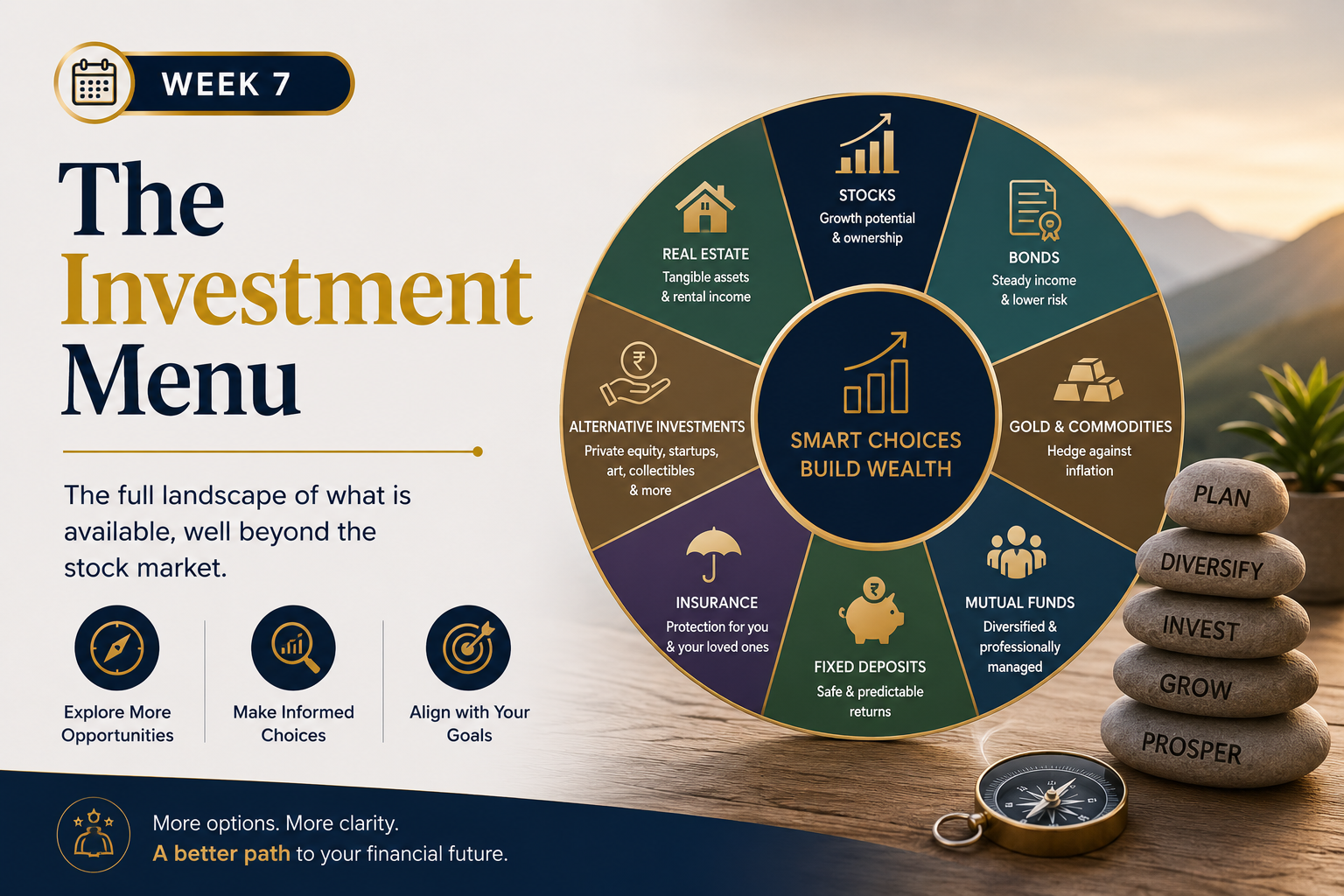
The Investment Menu

Most people think investing means buying stocks. It does not. I invest in real estate. I actively trade futures markets. I have capital in businesses. I have explored investment categories that most people in mainstream financial media never talk about. The world of investing is genuinely wide and the right investment for you depends entirely on your goals, your timeline, your current financial position, and honestly, your temperament. Some investments reward patience. Others reward active attention. In this module I am going to lay out the full menu of what is available to you, including the non-traditional and alternative categories that are often where the most interesting opportunities live. Most people who go through this module tell me they felt a door open that they did not know existed. That is exactly what I want for you.

Outcomes

  • Understand the full landscape of investment options available to you well beyond the stock market including real estate, business ownership, futures markets, and alternative assets
  • Learn how each investment category generates returns and what the real risks, time commitments, and capital requirements look like for each one
  • Evaluate alternative and non-traditional investments so you have a genuinely complete picture of what is possible rather than just the options your bank tells you about
  • Leave this module knowing which investment categories make sense for where you are right now and which ones to build toward as your wealth and knowledge grow

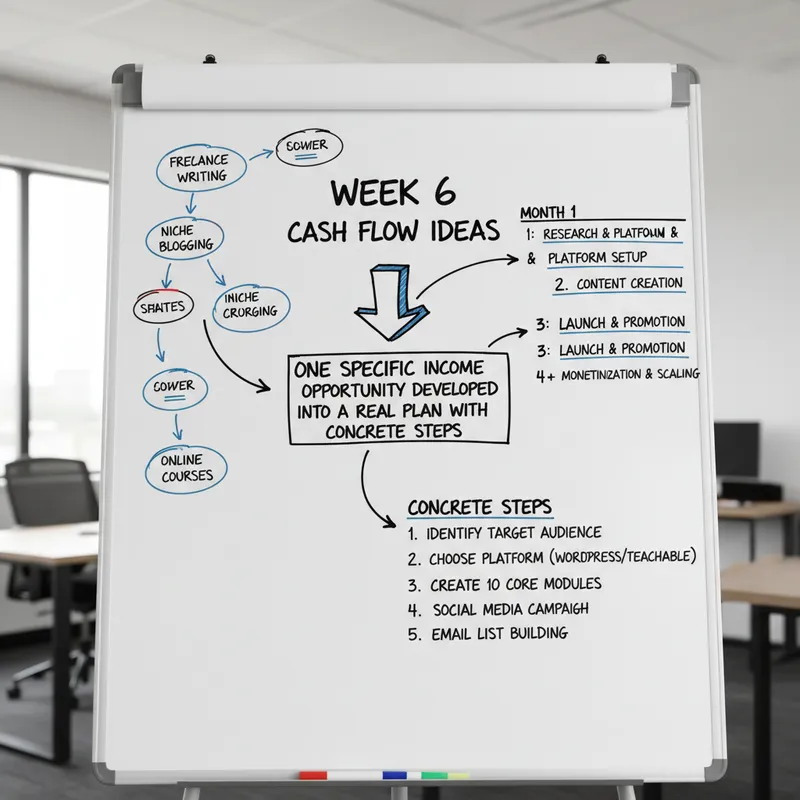
Cash Flow Ideas

Additional income does not come from working more hours. That is a trap I see professionals fall into constantly. You are already trading your time for money in one place. The goal is to create income that does not require you to trade more time. I learned this by looking honestly at what I was already good at, what I had already built, and how those things could generate returns beyond my primary salary. Whether that was consulting work, a business idea, a rental property, or a trading position, the principle is always the same. You want your skills, your assets, and your money working for you in more than one place at the same time. In this module we are going to identify where your highest value opportunities are right now and turn the best one into a real plan with real steps. Not a list of ideas. An actual plan.

Outcomes

  • Identify your highest value transferable skills and understand how they could be packaged into additional income without requiring you to add unsustainable hours to your life
  • Generate a specific list of realistic cash flow opportunities that fit your actual background, your genuine interests, and your available bandwidth right now
  • Evaluate each opportunity against a straightforward framework so you focus your energy on the one with the best return for your effort rather than trying to do everything at once
  • Build a concrete action plan for your top cash flow opportunity with milestones, resource requirements, and first steps you can begin this week
  • Understand how additional income streams connect to your broader wealth building strategy so each new stream feeds into assets rather than just lifestyle

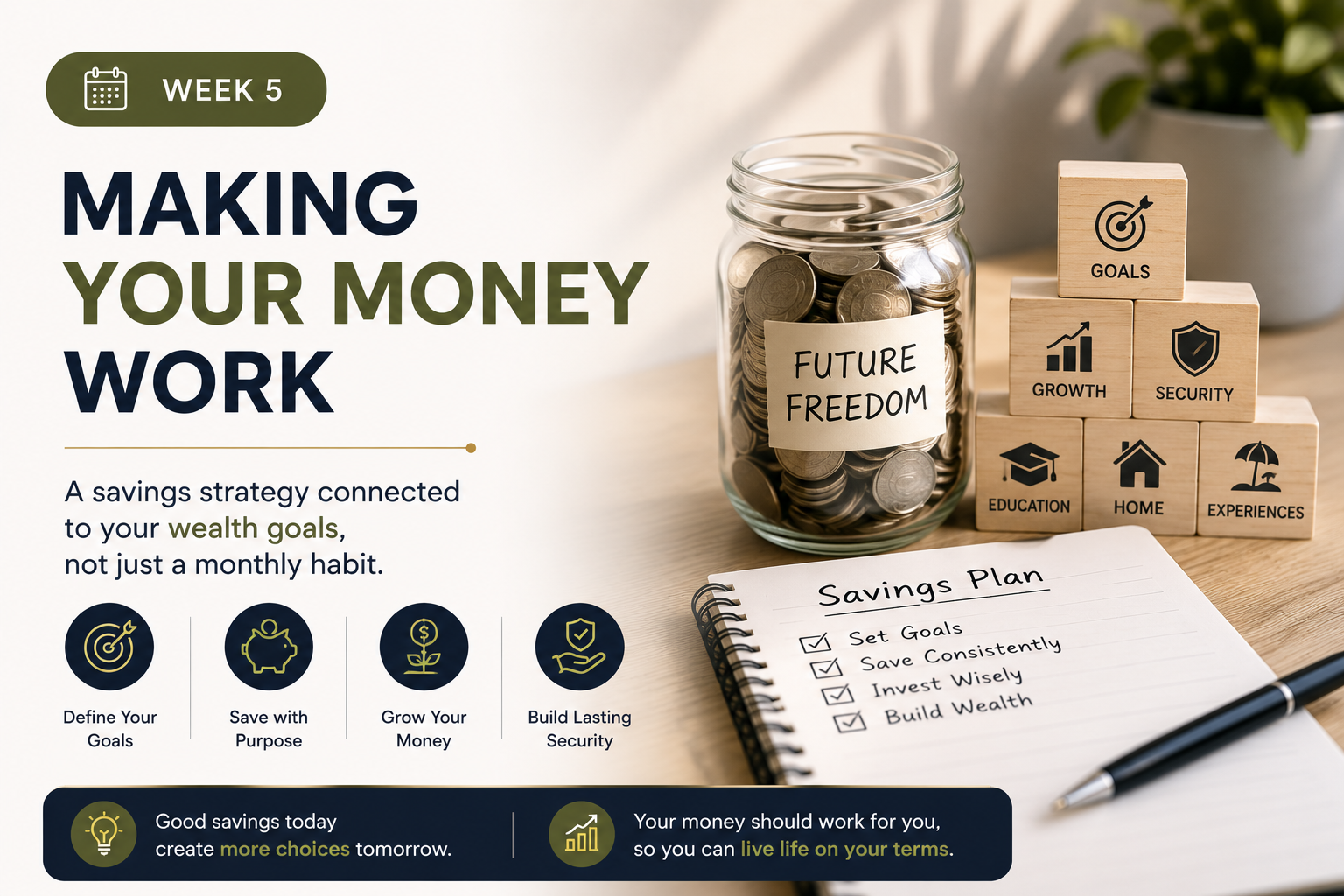
Making Your Money Work

I want to be direct with you about something that most financial coaches will not say. Saving money alone will not make you wealthy. Inflation will quietly erode the purchasing power of money that just sits in a standard savings account year after year. That does not mean saving is not important because it is, it is the foundation. But knowing where to save, how much to keep liquid, when saving is the right move, and when your money should be working somewhere else entirely, that is the difference between people who feel financially stable and people who are actually building wealth. In this module we are going to cut through all the jargon, look at what savings vehicles make sense in today’s environment, and begin mapping how you can generate additional income streams that increase how much you have available to save and invest.

Outcomes

  • Understand which savings vehicles actually make sense for your specific situation right now and which ones are quietly losing you money to inflation
  • Get clear on the right balance between liquid emergency savings, short term savings, and invested assets at your current stage of wealth building
  • Explore savings strategies that are connected to your bigger financial goals rather than arbitrary monthly targets
  • Identify multiple approaches to generating additional income streams so your savings rate can actually grow rather than staying stuck at the same percentage of the same salary
  • Leave this module with a savings strategy that is part of a wealth plan, not just a habit disconnected from everything else you are building

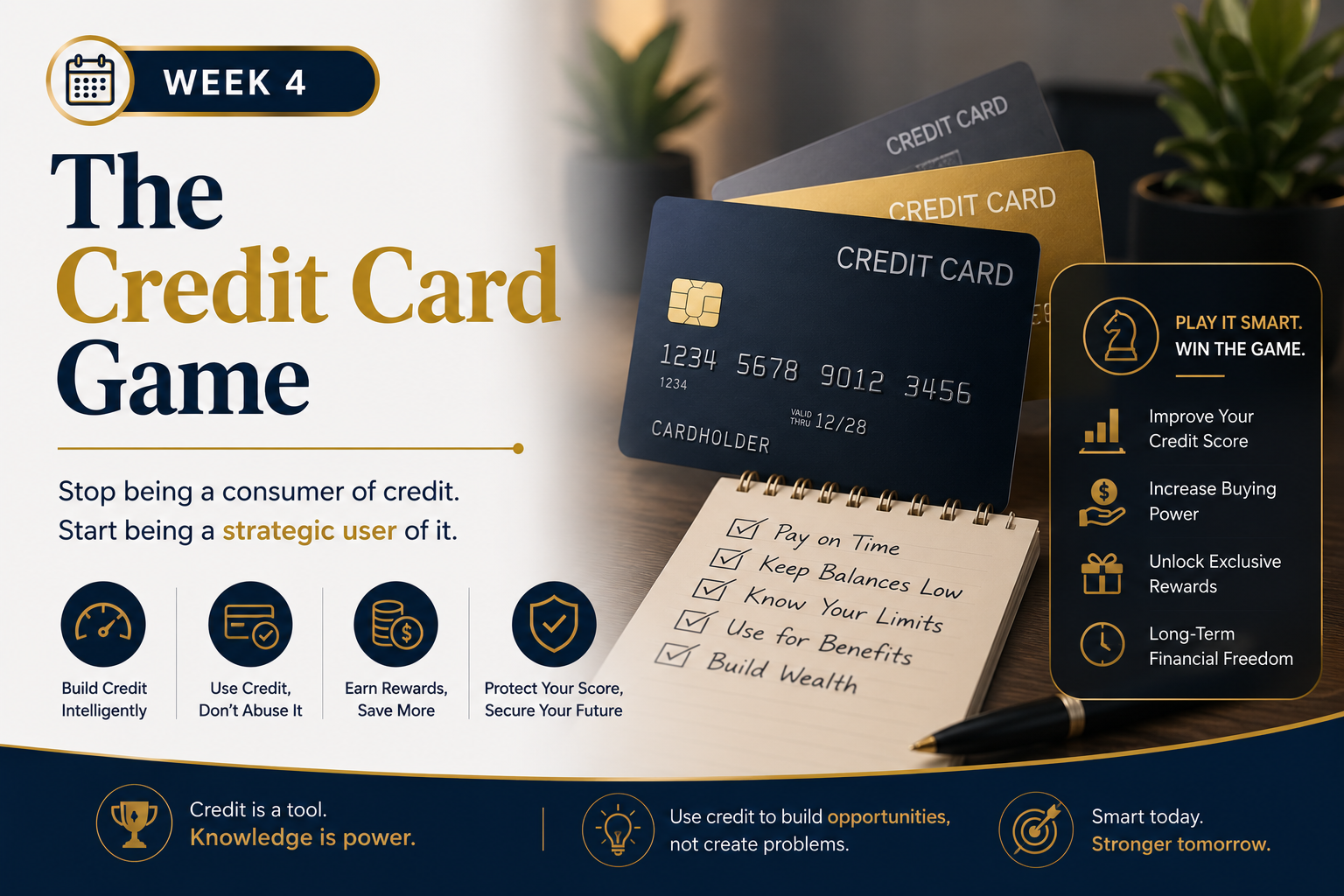
The Credit Card Game

I went from having no credit to an 838+ credit score. That did not happen because I avoided credit cards. It happened because I learned how to use them strategically and with intention. Banks and financial institutions are not your enemies but they are absolutely in business to make money off of you if you let them. And if you do not understand how they structure credit products and where they make their margins, you will spend your whole life on the wrong side of that equation. In this module I am going to show you exactly how the credit system works from the inside so you can stop being a passive consumer of credit and start being an active, strategic user of it. The difference between those two positions shows up directly in your net worth and your ability to fund the investments you want to make.

Outcomes

  • Understand exactly how financial institutions structure credit products, where they make their money, and how to avoid being on the losing side of that equation
  • Learn how your credit profile is built, scored, and maintained so you can manage it with intention and strategy rather than just hoping the number goes up
  • Develop a personal credit strategy that uses credit as a tool for wealth building, including using credit to fund real estate acquisitions and business investments
  • Build your credit toolkit including monitoring tools, dispute processes, strategic card selection, and utilization management
  • Walk away understanding how I built an 838+ credit score and the specific principles behind that journey that you can apply to your own

Your Vision

I have visited 16 countries. I have managed projects across multiple industries on multiple continents. I have built businesses, purchased properties, and traded financial markets. None of that happened by accident and none of it happened because I was hoping for the best. It happened because I got specific about what I wanted and I built a plan with real steps and real timelines to get there. This module is about doing exactly that for you. Not a vague idea of being wealthy someday. A specific, concrete vision of what your financial life looks like in two years, in five years, in ten. And then we go deeper into something most financial education programs never properly explain, which is the concept of leverage. Understanding leverage is what separates people who earn good money from people who build genuine wealth.

Outcomes

  • Define your specific financial vision with real numbers and real timelines, not a mood board but a blueprint
  • Understand leverage in all its forms, financial leverage, real estate leverage, business leverage, and time leverage, and identify which forms are most available and relevant to your current situation
  • Connect your personal vision to a direction that makes every financial decision going forward easier, because you will always know what you are building toward
  • Walk away knowing not just what you want financially but why you want it, because that why is exactly what keeps you going when building wealth gets uncomfortable or slow

Organizing Your Finances

If you have ever sat down to figure out where your money went and just felt overwhelmed, this module is going to change that permanently. I am a project manager. Organizing complex, scattered information and turning it into a clear, actionable picture is literally what I do for a living. In this module I am going to show you how to take everything that is currently spread across your bank accounts, your bills, your credit cards, and your mental load and bring it all into one organized view. Think of it as building your personal financial dashboard. Once it is built you will always know exactly where you stand.

Outcomes

  • Build your personal financial dashboard so that all income, expenses, debts, and obligations are visible in one place
  • Identify the gaps, the leaks, and the overlooked opportunities that are hiding in your current financial picture
  • Review your credit report as a financial document, not just a score, and understand what each line means for your wealth building plan
  • Prioritize the items that need your attention first using the same triage approach I use on complex consulting projects
  • Walk away with a system you will actually maintain, not a spreadsheet you look at once and abandon

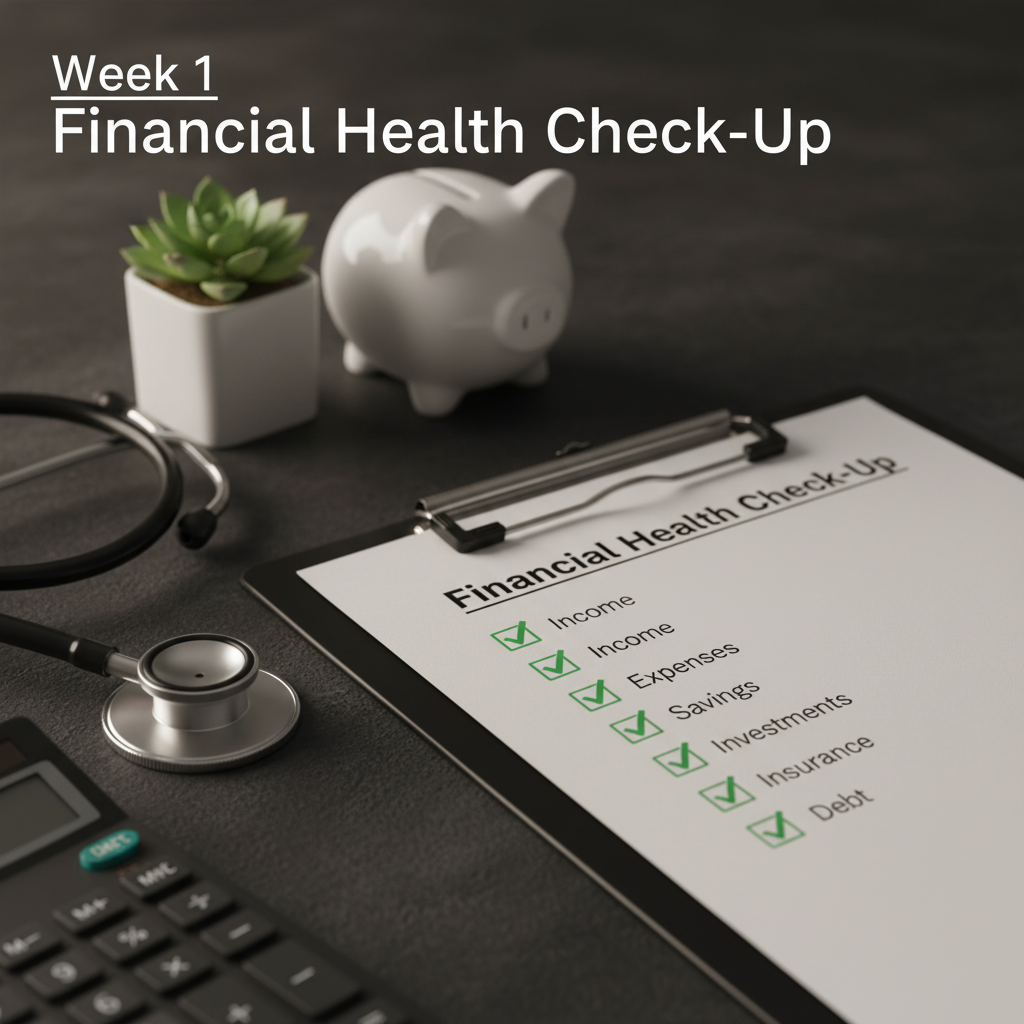
Financial Health Check-Up

You cannot fix what you will not look at. I know that sounds direct but after 15 years of working with organizations on complex projects I have learned that the most important first step is always an honest assessment of where things actually stand. Not where we hope they are. Where they actually are right now. This module is that honest look. We are going to go through your finances together the same way I would go through a project status report. No judgment. No shortcuts. Just clarity, because clarity is where every good plan begins.

Outcomes

  • Know exactly where every dollar of your income is going right now, not approximately, exactly
  • Understand your debt to income ratio and what that number means for your financial future and your ability to borrow
  • Pull your credit report and understand what is on it, what is helping you, and what is quietly working against you
  • Walk away with a clear, honest baseline so that every decision you make from this point forward is built on reality, not assumptions